Condition - Too Much/Too Little
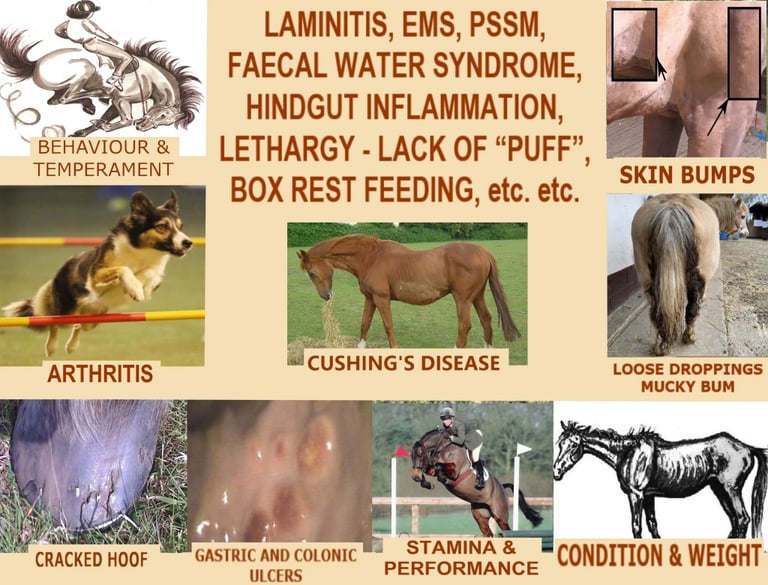
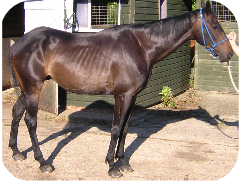
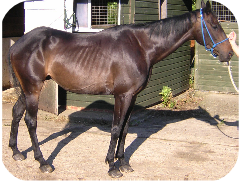
You have probably reached this page either because your horse has been losing weight, become skinny and thin and is lacking condition, or it’s been allowed to stuff itself, looks like a barrel on legs & at risk of problems such as EMS/insulin resistance/laminitis & joint problems etc. Click for advice on Equine Obesity .
Human error If in doubt seek advice – you should invest in weighing equipment – many feed merchants and tack shops stock spring balances for weighing hay nets and kitchen scales can be used for feed scoops.
Insufficient/Poor quality protein: Muscle consists of protein. Proteins consist of amino acids. All animals require a daily supply of suitable quality protein (must contain enough essential amino acids, e.g. lysine, methionine, etc) to maintain muscle and other protein. Hard working or growing animals have a much greater need for good quality protein. The author, in common with most horse feed manufacturers, used soya very successfully to ensure an adequate supply of essential amino-acids in the products he formulated. Much misinformation has been posted by ignorant people on social media- see FAKE NEWS
Illness suppressing appetite or impairing digestion: e.g. gut tumours, colic, scour, gastric and colonic ulcers, etc. Consult your vet.
Stress: e.g. bullying, travelling. Stallions are notoriously prone to weight loss during the covering season.
Worn or damaged teeth preventing a horse chewing its food properly, impairing food digestion.
Inadequate worming – serious damage can be caused to the gut, liver and blood vessels, which will cause condition and weight loss (as above) and ultimately death. Do not omit tapeworm from your worming programme!
Other parasites e.g. lice, mange, etc can in extremis have a debilitating effect.
Age – A horse’s digestive system will become less efficient over time. Pre- & probiotics such as brewers & live yeast can improve digestive efficiency.
Causes of Equine Weight Loss
Restoring Condition
Address the management problems listed above.
Check the diet – if necessary complete the Nutrition Enquiry Form so that John Chapman can evaluate it. Ensure good quality forage is available ad-lib. A horse needs at least 1.5% of its bodyweight per day of dry forage.
Increase the protein and energy content of your horse’s feed by adding full fat soya and/or micronised (cooked) linseed to the diet. Other quality sources include copra, cooked peas and cooked beans. Milk powder is only suitable for foals. Once weaned they lose the ability to digest lactose, which could cause various problems. Add vegetable oil to provide slow release energy
If the condition loss is only moderate, feed quality conditioning nuts such as Bailey's No4 Topline, mixes such as Body-Builda™, & balancers such as
Acceler8™ (forsports horse), LinGold™, Equi-Jewel® etc Vegetable oil - e.g. supermarket rapeseed - the least expensive - may be sufficient. Avoid sunflower & corn oils as these are inflammatory ( high omega-6 content)
EXCESS Weight/Obesity
For all species an excess of energy intake over usage will result in weight gain & can in extremis lead to problems such as EQUINE METABOLIC SYNDROME. Reversing it is obviously the opposite! However horses need a daily minimum of at least 1.5% of their normal bodyweight in dry forage to maintain gut health & will typically eat 2 to 3% given the opportunity. On adlib grazing or forage the energy intake can exceed that required for maintenance and result in fat horses.
Slimming your horse: this MUST BE DONE GRADUALLY otherwise gut problems will arise.
I. restrict grazing by turning out in a starvation paddock or track system. Provide some clean straw (preferably oat) to enable a hungry horse or pony to satify its appetite.
2. fit a grazing muzzle .
3 Restrict turnout time & preferably graze at night when grass sugar content is lowest.
4. Provide some clean straw in the stable (oat preferred).
5. Soak hay to remove excess sugars. This will remove required minerals & vitamins so you should feed a supplement or low-energy balancer to replace them. The latter is more expensive than a pure mineral & vitamin supplement & may provide unnecessary calories & proteins. Add to a low/sugar-free chaff with a little low-sugar soaked beet pulp for palatability.
6. Hay intake can be slowed down by use of small mesh or double nets. Floor level restrictive feeders are also available.
7. Increase exercise to use up surplus energy.
©Horseheath Nutrition
To Contact:
Call/text +44 (0) 7721 384508
whatsapp +44 (0) 7807 479495
Use the General Enquiry Form for e-mail