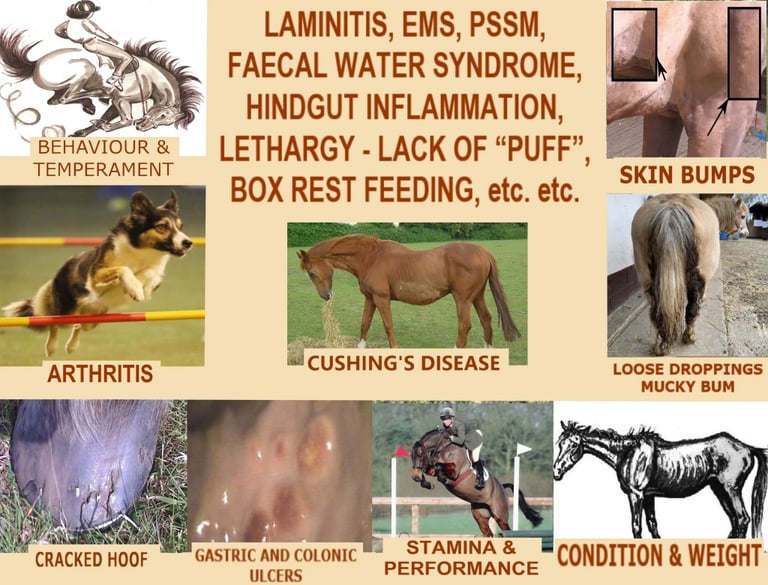
Principles of Horse Nutrition
Before you even think about owning a horse you need a bottomless bank balance or a rich partner who at least tolerates them & will provide a sympathetic shoulder to cry on when disaster strikes - as it inevitably will! All my lady customers loved their horses more than their husbands; children were on a par - there isn't much to choose between a cantankerous horse & a stroppy child, except size!
Horses have evolved over millions of years, developing a system which can digest large volumes of leafy green material, mostly grass. They are also able to digest succulent vegetables, fruit, cereals & fats & proteins. Horses in the wild eat intermittently from 10-18 hours per day taking in around 2- 3% of their bodyweight per day in dry fibre. At least 1.5% is essential for healthy gut function.


Some domesticated horses are allowed to continue this pattern when out at pasture 24/7. Many are not & their feeding is controlled by their owners. Grazing is restricted in varying degree & has to be supplemented with preserved forage. For many, especially sports horses, extra concentrated feeds are required. Typical ingredients are oats, barley, maize, peas, linseed, dried grass, chopped straw, soya & vegetable oil plus byproducts such oatfeed, wheatfeed, bran, sugarbeet pulp & molasses. Various mineral & vitamin supplements are added, with possibly pre-& pro-biotic & other supplements & medicines.
The horse has the standard mammalian digestive system of mouth, stomach , small & large intestine & rectum. After chewing food passes into the stomach where it is mixed with strong hydrochloric acid to initiate digestion & kill as many pathogens as possible . It then passes into the small intestine where fats, proteins & starches are broken down & pass into the bloodstream together with sugars & minerals & vitamins.
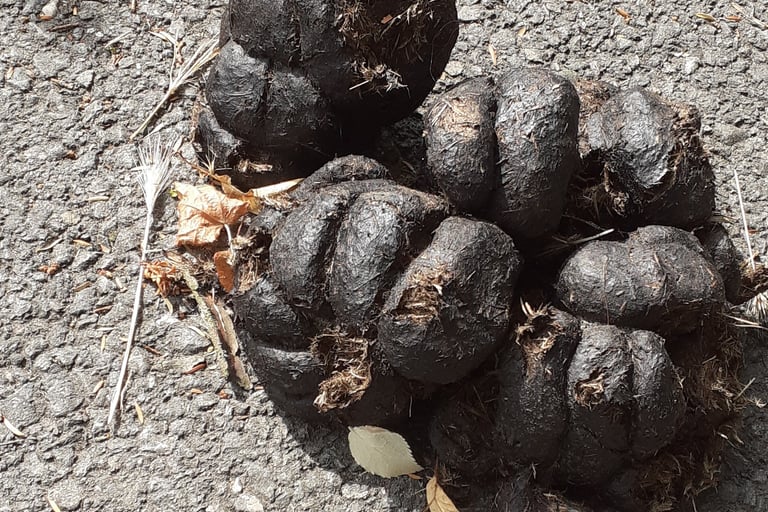
From there the food passes into the large intestine, which has developed into a large fermentation chamber where trillions of microbes break down the digestible fibre to volatile fatty acids which the horse uses for energy. Microbes also synthesise vitamins K & B-group. The undigestible residue then passes into the rectum where water is extracted to form the round droppings so beloved by poo-picking grooms!
The PERFECT POO!
©Horseheath Nutrition
To Contact:
Call/text +44 (0) 7721 384508
whatsapp +44 (0) 7807 479495
Use the General Enquiry Form for e-mail